
THE ANDEAN IN THE INCA PERIOD:
THE IMPORTANCE OF THE ANDEAN REGION IN THE INCA PERIOD: GEOGRAPHY, ECONOMY, CULTURE, AND SPIRITUAL SIGNIFICANCE
Introduction
During the Inca period, the Andes Mountains played a fundamental role in shaping one of the most advanced civilizations of pre-Columbian America: the Inca Empire, also known as the Tahuantinsuyo. Far from being an obstacle, the Andean geography became the foundation of Inca political organization, economic development, cultural identity, and especially spiritual life.
This monograph analyzes the importance of the Andes during the Inca era, focusing on geography, economy, culture, and their profound spiritual meaning. Additionally, it highlights how modern visitors can better understand this legacy through specialized cultural tours.
1. Geography of the Andes in the Inca Period
The Andes Mountains extend along the western part of South America and formed the backbone of the Inca Empire. The territory included present-day Peru, Ecuador, Bolivia, southern Colombia, northern Chile, and northwestern Argentina.
The Andean region is characterized by:
- High mountains and steep slopes
- Fertile inter-Andean valleys
- High plateaus such as the Altiplano
- Diverse climates depending on altitude
The Incas developed a sophisticated understanding of ecological zones, known as the “vertical archipelago,” allowing them to efficiently manage natural resources at different altitudes. This geographical diversity made possible agricultural production, trade networks, and communication across vast territories through an impressive road system known as the Qhapaq Ñan.
2. Economic Organization in the Andes
The Inca economy was based on agriculture, livestock, and collective labor, all adapted to the mountainous environment.
Agriculture
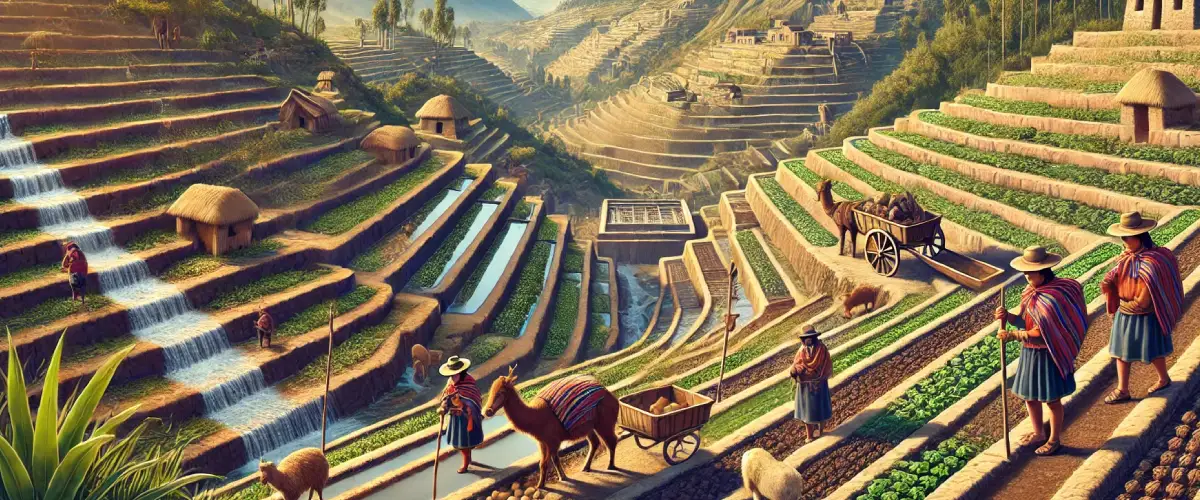
- Construction of agricultural terraces (andenes) to farm on mountain slopes.
- Advanced irrigation systems using water from rivers and glaciers.
- Main crops: potatoes, maize, quinoa, chili peppers, and coca leaves.
Livestock
The domestication of llamas and alpacas was essential for:
- Transportation of goods
- Wool production for textiles
- Meat as a food source
Collective Labor System
Economic life was organized through cooperation:
- Ayni: mutual aid among families.
- Minka: community work for public projects.
- Mita: labor service for the state.
There was no monetary system. Instead, the state redistributed goods to ensure collective well-being and survival in the challenging Andean environment.
3. Cultural Development in the Andean World
Inca culture was deeply shaped by the Andean environment.
Social Organization
Society was structured around the ayllu, an extended family community that shared land and responsibilities.
The Inca ruler was considered divine and served as the supreme political and religious authority.
Architecture and Engineering
The Incas mastered stone construction, fitting stones perfectly without mortar. Cities such as:
- Cusco
- Machu Picchu
- Sacsayhuamán
were harmoniously integrated into the mountainous landscape and designed to resist earthquakes.
Knowledge and Education
- Oral transmission of knowledge
- Use of quipus for accounting and administration
- Advanced astronomy, medicine, and hydraulic engineering
4. Spiritual and Religious Importance of the Andes
The spiritual dimension was the most significant aspect of Andean life. The Incas believed that nature was sacred, and the Andes were at the center of their religious worldview.
Sacred Mountains and Deities
- Inti, the Sun God, protector of the empire.
- Pachamama, Mother Earth, symbol of fertility and balance.
- Apus, the sacred mountain spirits and protectors of communities.
- Viracocha, the creator god.
Mountains were not simply geographical formations; they were living beings with spiritual power. Each community had a sacred mountain that guided and protected its people.
Rituals and Ceremonies
- The festival of Inti Raymi honored the Sun.
- Offerings known as “payments to the Earth” maintained harmony with nature.
- The Temple of Coricancha symbolized the union between religion, political power, and geography.
The Incas believed that human well-being depended on maintaining spiritual balance with the Andean world.
Experiencing the Andean Legacy Today
To truly understand the geography, economy, culture, and spiritual depth of the Inca civilization, it is highly recommended to explore the region with specialized guided tours.
Taking the Sacred Valley Tour allows visitors to discover key archaeological sites, agricultural terraces, traditional villages, and living Andean culture. Likewise, the City Tour in Cusco provides deep insight into Inca temples, colonial architecture, and sacred landmarks.
For a comprehensive and well-organized experience, travelers can book these tours with Only Cusco Travel, a professional local operator that offers expert guidance and cultural interpretation, helping visitors connect with the historical and spiritual essence of the Andes.
Conclusion
The Andes were far more than a physical setting for the Inca civilization; they were the spiritual, economic, and cultural foundation of the empire. The Incas transformed the challenges of the mountainous environment into opportunities through innovation, cooperation, and profound respect for nature.
Above all, the Andes held deep spiritual significance, as mountains, land, and natural elements were considered sacred and alive. This worldview allowed the Incas to create a harmonious society closely connected to their environment — a legacy that continues to inspire the Andean world today.
To fully appreciate this heritage, experiencing the Sacred Valley and Cusco through a guided cultural tour is not only recommended, but essential.